
The Proof Is in the Progress: What a Year of Student Growth Tells Us About How Children Learn
When learning is built around the student, growth follows. In this post, we share what a full year of diagnostic data reveals about our students, why the children who start furthest behind often climb fastest, and the story of one student whose progress captures it all.
In a recent family curriculum meeting, a parent said something I hear often. Her child, she told me, had simply decided he was not a math person, and she did not know how to argue with him anymore. We talked it through the way we always do, not by promising her it would turn around, but by looking honestly at where her son actually was and what was getting in his way. By the end of the conversation, the worry had not vanished, but it was named. That meeting is a good picture of how we begin with every family: we name the real concern, we look at the evidence, and we build from there. This year, the evidence has a lot to say.
Growth You Can Measure
We use diagnostic assessments as one tool to track how students are progressing across the core strands of math and English language arts. We run them at regular intervals so we have a real, comparable picture of where a child stands over time.
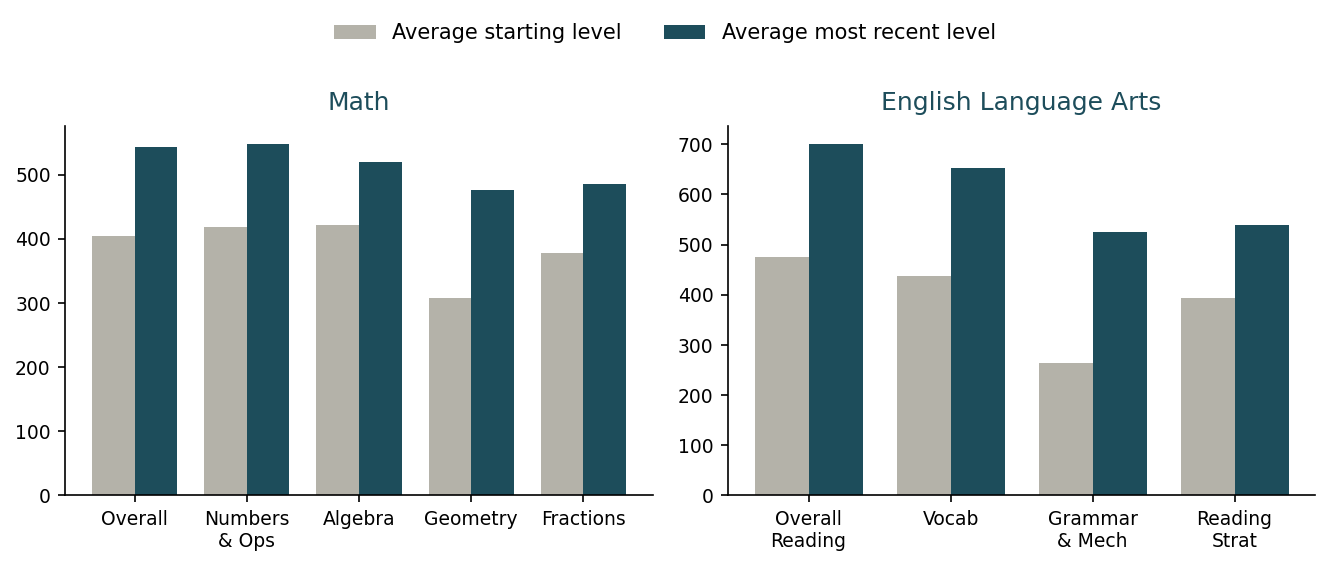
The results are encouraging. Most of our students gain at least a full grade level of proficiency in six months. A number of them gain considerably more progress. The trend holds across both math and English and across nearly every strand we track.
In math, average levels climbed across the board: overall math, numbers and operations, algebra, geometry, and fractions. Geometry showed the largest gains, often indicating some of the lowest scores in math compared to other strands. In English language arts, reading, vocabulary, and reading strategies all moved up. The steepest gains of any strand we track were in grammar and mechanics, which makes sense: it is the area where students most need instruction, because it runs through every component of reading and writing.
Why the Children Who Start Behind Often Move Fastest
The students who arrive furthest behind frequently show the steepest gains, which often surprises people. The worry many families carry into that first meeting is that a child who has fallen behind will only keep falling. In our experience, the opposite tends to be true once the fit is right.
When we know exactly where a student is, identify the specific gaps, and teach the way his mind actually works, the progress can be rapid. Fractions are a good example. When we see it as an area of need, our teachers address it directly, and nearly every student who needed that work showed real improvement. Name the gap, teach it, measure the result. That is the whole loop, and the data shows it working.
Violet's Story
The averages tell part of the story, but Violet’s story paints the picture.
When a student we will call Violet began with us in January, math was a source of genuine dread. She was in middle school and still counting on her fingers, bracing herself before every problem in a classroom where her peers had long since moved on. Violet has dyslexia and what we suspect is dyscalculia, which means the conventional classroom had unintentionally spent years quietly teaching her that she was bad at this. Her diagnostic assessment that month placed her overall math level at a 230, which equates to an early to mid-second-grade level.
Four months later, Violet tested at a 360, a full grade level growth in roughly a third of the time. The gains run across every strand: geometry climbed from 120 to 435, algebra from 210 to 370, numbers and operations from 230 to 390. More importantly, Violet went from concrete reasoning (the finger-counting stage) to abstract reasoning (the ability to hold and work with numbers in the mind).
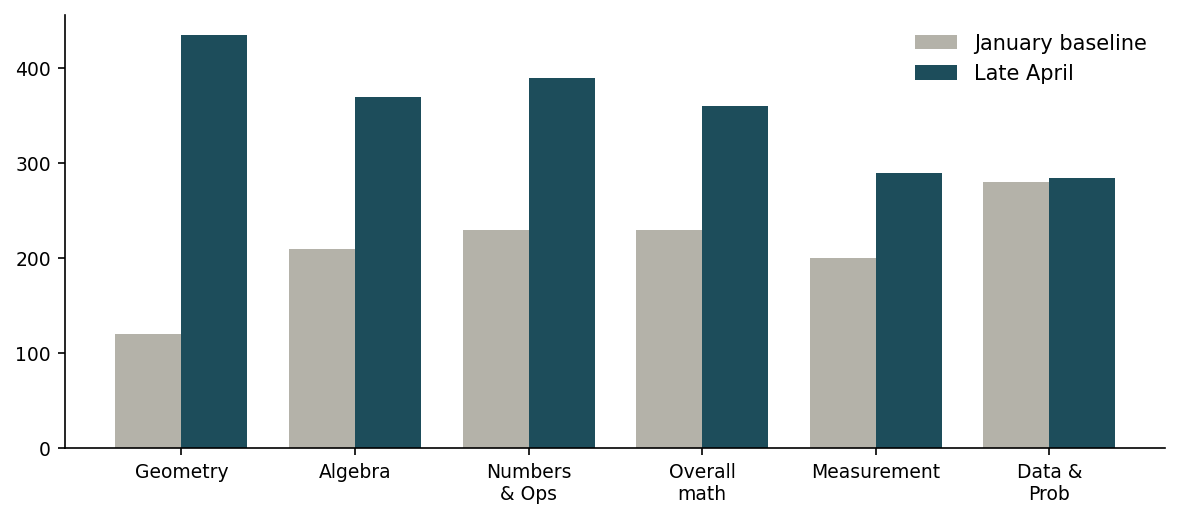
The data describes that the 1:1 approach is working for her. She not only made improvements, but is demonstrating ongoing retention as material becomes increasingly complex. And yet, the score is not what moves us most. The Violet who shows up to math now volunteers answers, asks clarification questions, and gets visibly excited to go through long, complex problem-solving. A child who previously believed she couldn't access math is not only accessing it, but applying her understanding with confidence and ease.
What the Data Tells Us
For years, we have described our students' growth through qualitative stories:
The child who looks forward to classes
The student who advocates for herself
The older sibling who sees their younger brother completing his homework independently
Those moments are real, but they're hard to pin back to what this year's data gives us. The numbers move in exactly the direction our teachers have been describing. Violet's leap is not an outlier dressed up as a trend. It is one vivid instance of a pattern that runs consistently through our school. When teachers find what works well for their students, learning flourishes as a result, and confidence builds. When we see the child grow, we see it through qualitative and quantitative means.
