
Many families are happy with their child’s school but want one part of the academics to look different. A single outside course can help a student move ahead in math or language, explore a subject their school doesn’t offer, or take a hard class at a gentler pace. This guide explains the course formats, how to check accreditation, where to find your school’s and district’s credit rules, and what to say to your counselor. It also includes a note for families of elementary and middle school students.
Many families can say that overall, they are satisfied with their student’s school experience, but they just want one piece of the academics to look different. Adding a single course for credit could make it all work even better. Here are the most common reasons to explore the options.
One is for advancement within a subject progression. A student who didn’t take Algebra until 9th grade now wants to complete Calculus by graduation, which usually means doubling up on math somewhere along the way. Or they want to finish their language requirement early so there's room for electives later. Some students want a class their school simply doesn't offer, like psychology or computer science, or a deeper dive into something they love. Colleges tend to like seeing that kind of initiative, too.
Sometimes, one class is extra hard for their student. Romance languages can be a particularly heavy lift for a student with dyslexia, and a classroom of 28 doesn't leave much space to go slowly.
None of this requires changing schools. A student can take one outside course and keep everything that is working well. The part that takes some homework is choosing the right provider and making sure the credit counts, so this guide covers what to look for in a provider, where to find your school's rules, and what to say to your counselor. If your child is in elementary or middle school, there's a short note near the end, because the rules are different.
What this looks like
Some examples of students who have worked with us:
A freshman was on the standard math track, which would put Precalculus in senior year and no Calculus before graduation. To be competitive with highly selective colleges, the student enrolled in a full year of Algebra 2 over the summer before 11th grade. Before signing up, they asked the counselor two things: would the credit be accepted, and would the school require a placement exam to enter the next course in the fall? (The second question matters more than people expect.)
Another student wanted a lighter senior year with room for electives and AP courses, so the student planned to finish two years of a language early, one summer at a time. Each time, they confirmed with the school that the credit would count and that the course was UC A-G approved, as they lived in California and planned to apply to the UC universities.
An eleventh grader loved psychology, but the school didn't offer it. The family found an online psychology course, checked that it was accredited, and asked the counselor how it would show up on the transcript. It allowed the student to show their commitment to pursuing their academic interests on college applications.
A tenth grader with dyslexia was doing fine in most subjects but French homework was taking 2+ hours a night. The class had twenty-eight students and moved at a pace that assumed the sounds and spellings came easily. The family asked whether the school would accept credit for a French course taught one-on-one, at a slower speed, with a teacher who adjusts to how the student learns. The student had the option to schedule class during the school day, or have a free study hall period and hold the French sessions in the evening.
Some students need a summer course to repair a grade (policies on replacing a grade vary by school). Illness, travel, or a move can interrupt a semester, too. One ninth grader missed several weeks for a health reason and fell behind in two classes. Instead of repeating the year, the family added two outside courses for one semester, with the counselor's approval, and the student went back to a full schedule the next fall.
Live or self-paced
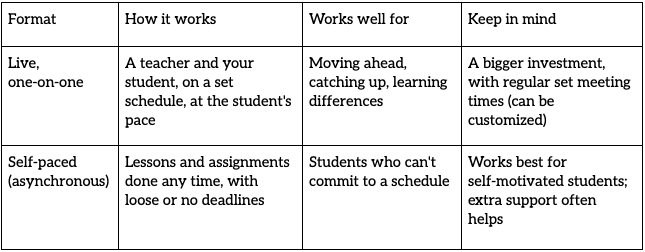
Outside courses come in two main formats, and the format matters as much as the provider.
Choosing an asynchronous option
Some schools will only give credit for asynchronous or self-paced courses, or scheduling constraints require that format. If that's your situation, it can still work, but it helps to know where these courses tend to fall short.
There's often very little teaching. Many self-paced courses are readings, videos, and auto-graded quizzes. When your child hits a concept they don't understand, there may be nobody to ask, or the answer takes days.
Loose deadlines invite drift. A course meant to take a semester can stretch into a year, and completion rates for self-paced courses tend to be lower than for live ones.
Feedback is thin. Auto-grading can tell a student an answer was wrong but not why, which is a real problem in math and writing.
It asks a lot of a student's executive function. Managing your own pace is a skill many students are still building.
Quality varies. Some programs are rigorous, and some are easy to rush through.
That said, self-paced is the right choice for some students, especially those who can't commit to a fixed schedule because of travel, a heavy training or performance schedule, or health that comes and goes.
If your child goes this route, you can add live support. Because there's so little teaching built into a self-paced course, a tutor can fill the gap: one session a week to teach the concepts, check the work, and keep the pace moving. Our tutors work alongside self-paced courses for exactly this reason.
One more caution. Colleges want to see that a student truly learned the material as opposed to checking a box. A fast, easy finish in a core subject like math, science, or English can raise questions. Strong grades in the next course in the sequence, a good teacher recommendation, solid test scores, and a student who can talk about what they learned all help. If the course is a stepping stone, like Algebra 2 before Precalculus, the next course will show whether it stuck.
Accreditation in plain terms
When your school looks at an outside course, accreditation is usually the first thing they verify. There are really three separate things to look for.
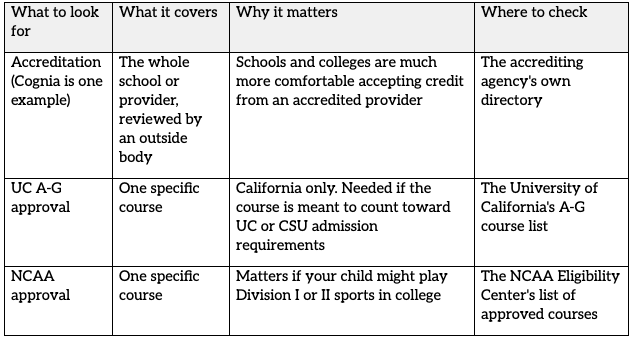
A provider can be accredited and still offer a course that isn't A-G approved, so check the exact course title you're enrolling in.
A quick note if you're not in California: A-G is a California system, so it only matters for students applying to the University of California or Cal State. Colleges in other states usually look at the transcript against their own published requirements, which spell out how many years of math, English, science, and language they want, so check the admissions pages of the colleges on your list. Your state's graduation requirements come from its Department of Education and your district, and some states keep a list of approved online course providers, so ask your counselor whether yours does. Cognia accreditation is recognized across the country, and NCAA eligibility works the same way in every state.
Questions worth asking any provider:
Who accredits you, and can I look you up in that directory?
Is this exact course UC A-G approved? NCAA approved?
Will you send an official transcript to my child's school?
Is the class live or self-paced, and who teaches it?
For a student outside California, swap the A-G question for two others: will my child's school and state accept this credit, and does it meet the requirements of the colleges we're considering?
Where to find your school's and district's rules
Start with the school's handbook, course catalog, or program of studies. Search for "outside credit," "transfer credit," "concurrent enrollment," and "summer school," and find the graduation requirements page.
Then look at the district's board policies. Most public districts post them online, and the sections on graduation requirements and credit for coursework done elsewhere are the ones you want. Private schools don't have a district, so the handbook or the counseling department or academic dean may be the point of contact.
Determine whether approval is needed before the course starts, whether there's a cap on outside credits, whether the grade shows up on the transcript and in the GPA or only the credit does, and whether the school requires a particular accreditor or A-G approval.
What to say to your counselor
Talk to the counselor before you enroll, and get the answer in writing. They're supporting a lot of students, so a short, specific email goes a long way.
A first email might look like this:
Hello [Counselor's name],
We are considering [course name] for [student's first name] next semester because [the reason, such as wanting to move ahead in math, the pace of the current class, or the school not offering the course]. Before we enroll, could we find out whether the school would accept credit for this course from an accredited outside provider?
We would also like to know the approval process and any deadlines.
Thank you, [Your name]
Questions to bring to the meeting:
Will this credit count toward graduation, and in which category, such as math or elective?
Will the grade appear on the transcript and count in the GPA, or only the credit?
Is there a form, a deadline, or a signature required, and from whom?
Does the school require a particular accreditor, or UC A-G approval for this subject?
Is there a limit on outside credits, and does this course affect prerequisites or sequencing?
How and when should the provider send the transcript?
If the answer is no, what would change it? A different course, a different provider, or an appeal to the department or principal?
A note for K-8 families
Credits, graduation requirements, UC A-G, and NCAA eligibility mostly start to matter in high school, so the rules for kindergarten through eighth grade are usually different.
Many elementary and middle schools do not award course credit at all. The question is less "will this count?" and more "how will this fit?" Ask your school how it views an outside course as a supplement, whether it could change your child's placement in the next grade, and how the school would like to be kept informed. An outside course meant to add to what happens at school is often a simpler conversation than one meant to replace part of the school day, so ask first in that case.
Middle school is different in one way. Algebra, geometry, or a world language taken in seventh or eighth grade can sometimes count toward high school credit, so treat those courses like high school courses and ask early.
As with everything above, the school handbook and your district's policies come first, and the counselor or principal can tell you what applies to your child. Exceptions to policies can sometimes be made depending on a child’s IEP.
Where Pacific Preparatory fits
Pacific Preparatory is a Cognia-accredited virtual school, and families can enroll with us for a single course or full time. Our courses are taught live and one-on-one, scheduled during the school day or in the evening, and we offer UC A-G approved and NCAA-approved courses. Whether your student wants to move ahead, explore something their school doesn’t offer, or take a hard class at a gentler pace, we’d love to talk through what would fit and what your counselor will want to see. You can start the conversation here.